

Categories: Alsace and Lorraine, French History
This episode features our frequent and very popular guest Elyse Rivin. If you enjoy her episodes, please consider supporting her on Patreon.
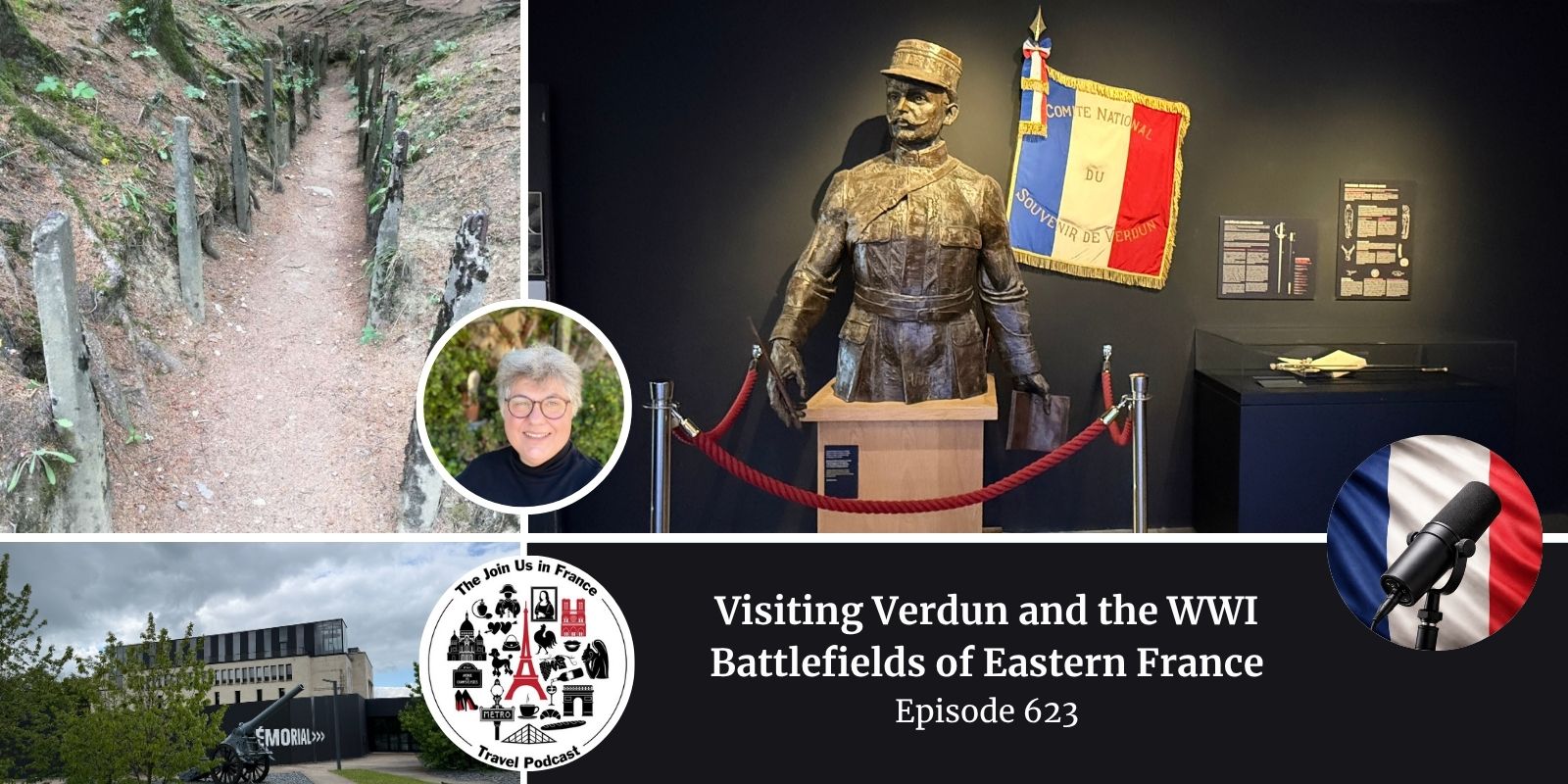
With November 11 coming up, I wanted to put out an episode about the First World War. Elyse Rivin and I talk about the sites to see in the Grand Est, where most French and American soldiers fought, and everything you need to plan a Verdun battlefield visit. It’s not a fun subject. But if you want to understand France, you have to understand World War I. It traumatized the country, and its consequences shaped everything that came after.
Where the Americans Fought: Meuse-Argonne and Montfaucon
If you’re American, start at the Meuse-Argonne American Cemetery. It’s the largest American military cemetery in Europe, with more than 14,000 graves. It honors the soldiers of the Meuse-Argonne Offensive, the largest operation the US Army had ever undertaken. The visitor center does a good job explaining both the scale of the campaign and the individual stories behind it.
Eleven kilometers away, the Montfaucon American Monument stands on a hill that American forces captured in 1918. The view from the top shows you why holding the high ground mattered so much, and how hard it was to move an army across this terrain.
The Must-See Stops on a Verdun Battlefield Visit
The Battle of Verdun lasted 303 days, from February to December 1916. About 163,000 French soldiers and 143,000 German soldiers died there. On a Verdun battlefield visit, these are the places I’d prioritize:
-
- The Verdun Memorial. In my view, it’s the finest military museum in France. More on it below.
- The Douaumont Ossuary. Two kilometers from the Memorial. Through windows at its base you see piles of bones collected from the battlefield, French and German alike. It’s graphic, and you won’t forget it.
- Fort Douaumont. The largest fort in the Verdun defensive system. You walk through the underground galleries, barracks and gun positions where soldiers lived for months at a time.
- Fort Vaux. Smaller, but known for Major Raynal and his men holding out against a German assault.
- The Trench of Bayonets. It marks the spot where French soldiers were said to have been buried standing in their trench, bayonets sticking out of the ground. Historians debate the story, but the monument is a powerful symbol.
- The Butte de Vauquois. Here the two armies fought underground, digging miles of tunnels and setting off hundreds of mines beneath each other.
- Further out, the Chemin des Dames tells the story of the disastrous 1917 Nivelle offensive and the mutinies that followed. Belleau Wood is where the US Marines earned their reputation in June 1918, and the Aisne-Marne American Cemetery is nearby.
Inside the Verdun Memorial Museum
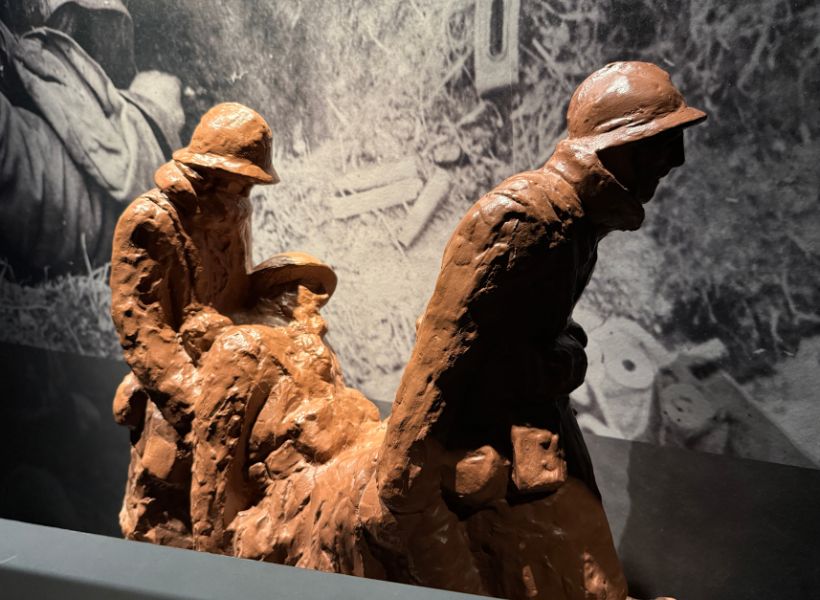
I read every panel, and it was hard going emotionally. The museum walks you through the first day of the battle, February 21, 1916, hour by hour. It also tells the story of Fernand Marche, a runner killed carrying a message whose body was found with his arm still raised, the message in his hand.
There are sections on the French soldiers executed “pour l’exemple,” on mail and censorship (one of my grandfathers was a postmaster at Verdun and survived), on the women who ran farms and families, on mobile surgical units called Autochirs, and on the Gueules Cassées, the men who came home with terrible facial wounds. There’s also a section on artists at the front and one on the air war, including the American volunteer pilots who flew French planes. One line from a soldier’s letter stopped me: “Maman, j’ai 20 ans, et je ne veux pas mourir.”
Where to Stay and How Long to Plan
Verdun is a small town. I’d stay in Metz instead. It’s under an hour from Verdun on the freeway, and in a city you can take a break from the war: go to a museum, see a show. You need that, because visiting these sites day after day is heavy.
Plan about three days for a Verdun battlefield visit, and a couple more around Reims. If you want to follow the whole Western Front, a rough plan would be two nights in Ypres in Belgium, two in Arras, two in Reims, three in Verdun or Metz, and two or three in Colmar.
Films and Books to Prepare
Elyse recommends watching La Grande Illusion by Jean Renoir, Un long dimanche de fiançailles by Jean-Pierre Jeunet, Paths of Glory by Stanley Kubrick, King and Country by Joseph Losey, War Horse by Steven Spielberg and 1917 by Sam Mendes. For reading: Johnny Got His Gun by Dalton Trumbo (disturbing, be warned), The Price of Glory by Alistair Horne, The Guns of August by Barbara Tuchman and All Quiet on the Western Front by Erich Maria Remarque.
Also in This Episode
In the magazine segment, I talk about the Statue of Liberty exhibition at the Musée d’Orsay, open until January 31, 2027, and why French drivers are switching to electric cars as fuel prices climb.
Join Us in France Newsletter
If you’d like more stories like this, plus what’s happening behind the scenes of the podcast, sign up for my newsletter at joinusinfrance.com/newsletter. It’s short, and it comes out with each episode.
More episodes about French history
#JoinUsInFrance, #FrancePodcast, #Francophile, #FranceTravelTips, #RealFrance, #Verdun, #WWI, #WorldWarI, #FirstWorldWar, #GreatWar, #Armistice, #RemembranceDay, #VeteransDay, #GrandEst, #Lorraine, #Meuse, #Metz, #WWIHistory, #BattlefieldTour, #FrenchHistory
FOLLOW US ON:
Discussed in this Episode
- Grand Est
- Alsace-Lorraine
- Metz
- Meuse-Argonne American Cemetery
- Montfaucon American Monument
- Verdun
- Verdun Memorial
- Episcopal Palace of Verdun
- Meuse River
- Bar-le-Duc
- Douaumont Ossuary
- Douaumont National Necropolis
- Fort Douaumont
- Fort Vaux
- Fort Thiaumont
- Trench of Bayonets
- Côte 304
- Butte de Vauquois
- Department of the Meuse
- Chemin des Dames
- Belleau Wood
- Aisne-Marne American Cemetery
- Reims
- Hauts-de-France
- Calais
- Arras
- Vimy
- Bully-les-Mines
- The Somme
- Colmar
- Western Front
- North Sea
- Swiss Alps
- Belgium
- Ypres
- Menin Gate
- In Flanders Fields Museum
- Tyne Cot Cemetery
- Langemark German Cemetery
- Essex Farm
- Sanctuary Wood (Hill 62)
- Dodengang (Trench of Death)
Subscribe to the Podcast
Apple YouTube Spotify RSSSupport the Show
Tip Your Guides Extras Patreon Audio ToursIf you enjoyed this episode, you should also listen to related episode(s):
- Chateau-Thierry and the Battle of Belleau Wood, Episode 256
- Exploring Vimy Ridge: WWI Remembrance in France, Episode 519
Read more about this episode
TranscriptCategories: Alsace and Lorraine, French History