


Categories: Learn French, Provence
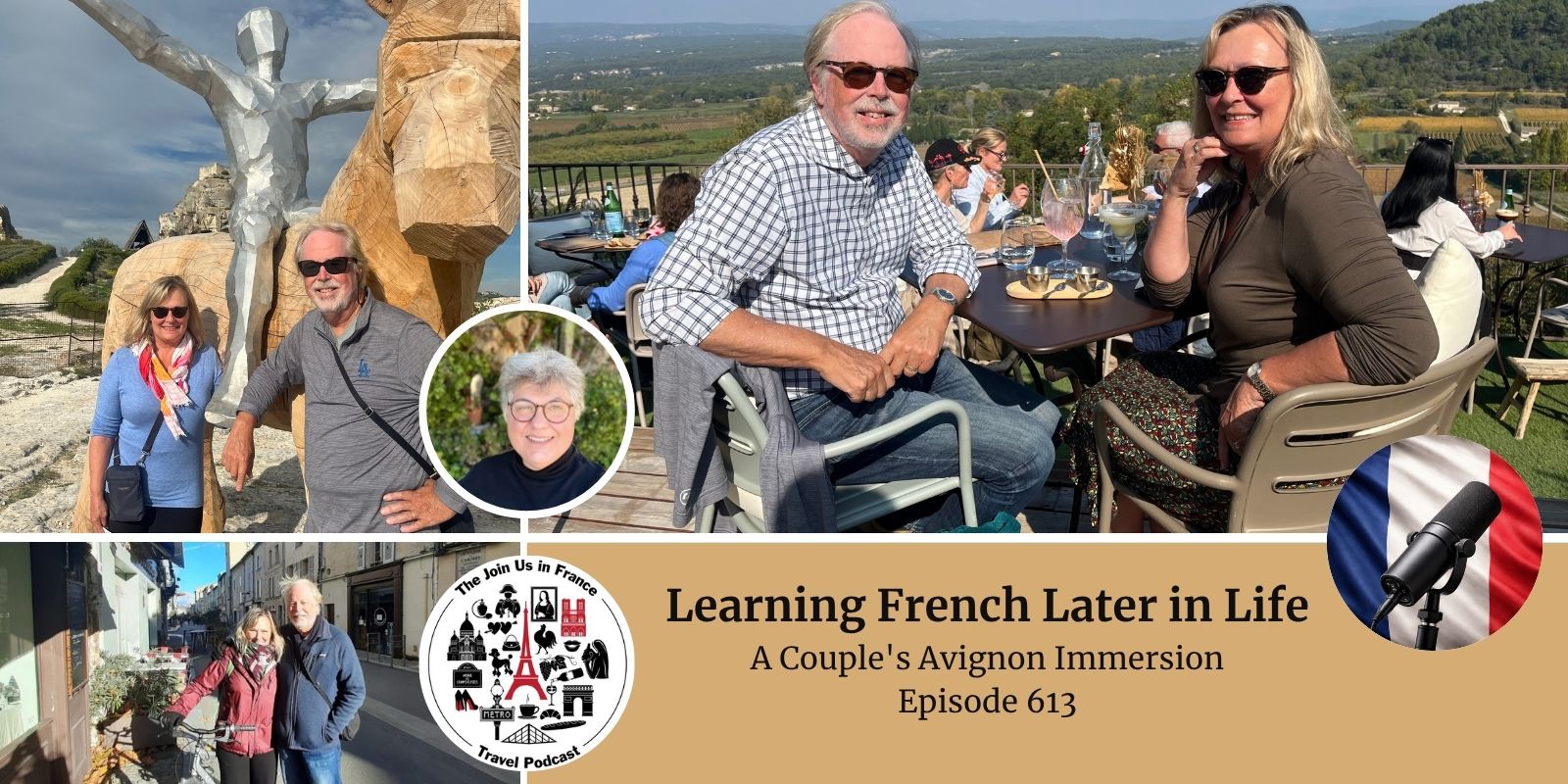
Nan and Marty Deniston have been visiting France for decades, but this year they did something different: they spent three months living in Avignon, built almost entirely around learning French later in life. Marty didn't start learning French until his fifties, and Nan grew up with a French teacher for a mother. Together, they figured out what actually works when you want to get serious about the language as an adult, not just brush up before a trip.
Listen to this episode ad-free
Two Very Different Starting Points
Nan learned French in high school, majored in it in college, and spent her junior year living with a family in Toulouse. Marty spoke Spanish from a year in Madrid but didn't understand a word of French until his mid-40s, when he and Nan started visiting France regularly. He got tired of sitting through dinners with French friends, unable to keep up with the conversation, so in his fifties he started taking classes. He's about 70 now, and while he says he's nowhere close to fluent, he can hold a real conversation. That's the whole point: learning French later in life doesn't require perfection, it requires momentum.
Why Three Months, and Why Avignon
The couple didn't jump straight into a three-month stay. A few years earlier, they did a one-week immersion in Avignon through Julie Gaudin's program, Le Français chez Julie, and came away loving the city. From there, they planned a longer stay of exactly three months, the maximum allowed in France without a long-stay visa. Finding housing took Nan about six months of searching VRBO, Gîtes de France, and the local tourism office. She wanted a house just outside Avignon's medieval walls, close enough to walk into the city but with parking for a car. She found it: a turn-of-the-century house that happened to belong to an American family.
Building Days Around Lessons and Excursions
Julie connected them with Fanny Foures, a certified teacher who met with them for two-hour conversation sessions twice a week, often at a pub. No grammar drills, just talking. Marty says that unstructured conversation helped him more than any class, because he stopped worrying about how a word was spelled and just repeated what he heard. Their days followed a rhythm: mornings at the boulangerie, lessons or excursions built around a two-hour lunch (because everything closes between noon and 2pm anyway), and three or four day trips a week to villages in the Vaucluse and Luberon. They even took cooking classes, including one at La Mirande's underground medieval kitchen, and prepared a full cassoulet from ingredients bought at Les Halles for Fanny to taste-test.
The Practical Side: A Car Lease and a Rented-Out House
Two details are worth flagging for anyone planning something similar. First, they leased a car through what's called the TT program (Temporary Transit), available through Auto Europe to non-EU residents staying between 21 and 175 days anywhere in the EU. Three months, all in, cost $2,500, with zero-deductible insurance. Second, to cover the cost of the trip, they rented out their own house in Santa Barbara instead of paying for a French rental out of pocket. They skipped Airbnb entirely, both there and in France, and used VRBO and Gîtes de France instead.
Villages Worth the Detour
Nan and Marty have opinions, and they're not afraid to share them. Vaison-la-Romaine impressed them for its Roman ruins and medieval town, Arles was a favorite, and Cassis charmed them as a seaside town. For hidden gems, Nan points to Séguret, a small hillside village, and Oppède-le-Vieux, reached by a scenic trail. Eze, despite its reputation, disappointed them: a turnstile entrance and wall-to-wall tourists. Uzès, on the other hand, sits underrated near the Pont du Gard and is worth the 35-minute drive from Avignon. They also visited the monasteries at Montmajour, just outside Arles, and Fontfroide, further south.
What Didn't Work
Not everything about a long stay is charming. Marty is quick to admit that the midday closures, the entire country shutting down from noon to 2pm, and the cold mistral winds that arrive by November were real adjustments. But he also makes the case that this rhythm forces you to slow down, which is exactly what draws so many people back to France in the first place.
By the end of three months, both Nan and Marty say their French had genuinely improved, not because of any app or course, but because of the people they met along the way: neighbors, teachers, workmen, strangers at a hunting-season dinner table. That's really the takeaway for anyone serious about learning French later in life: find a way to be surrounded by it, and talk to everyone who will talk back.
If you'd like more stories like this one, delivered every week, sign up for my free newsletter at joinusinfrance.com/newsletter.
More episodes about learning French
#JoinUsInFrance, #FrancePodcast, #Francophile, #FranceTravelTips, #RealFrance, #VisitFrance, #TravelFrance, #ExploreFrance, #OffTheBeatenPathFrance, #FrenchCulture, #FrenchHistory, #LoveFrance, #BonjourFrance, #FranceVacation, #TravelPodcast, #FrenchVillages, #ChateauxDeFrance, #FranceItinerary, #SlowTravelFrance, #MovingToFrance
FOLLOW US ON:
Subscribe to the Podcast
Apple YouTube Spotify RSSSupport the Show
Tip Your Guides Extras Patreon Audio Tours
Read more about this episode
TranscriptCategories: Learn French, Provence