

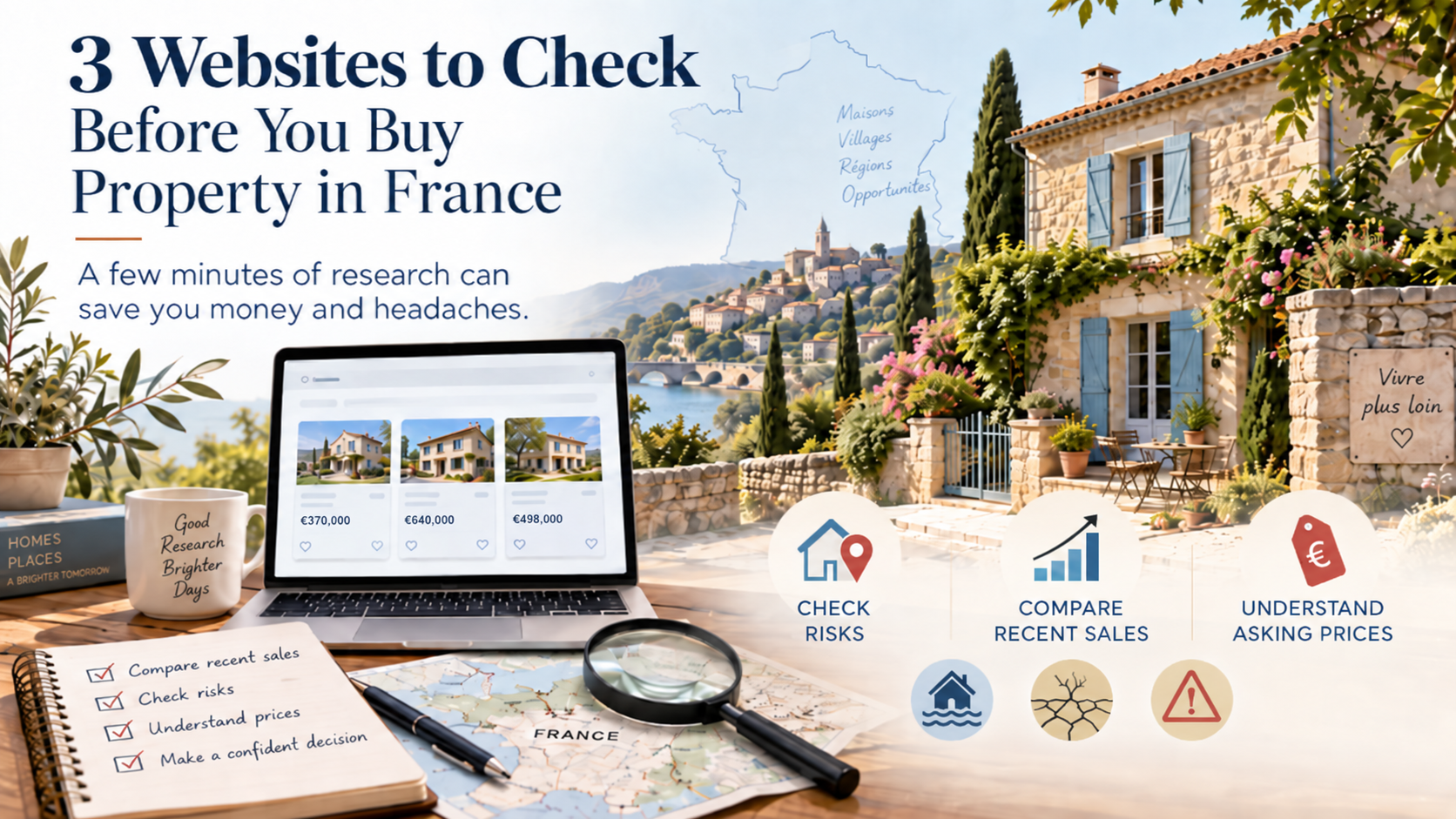

Buying a home in France can be exciting, but it’s easy to get swept up in the charm of a house and overlook the practical details. Before you fall too hard for a property, spend a little time doing some homework. These three websites can help you spot potential risks, understand what nearby homes have actually sold for, and get a clearer sense of whether the asking price makes sense. A few minutes of research now could save you a lot of money and frustration later.
Géorisques.gouv.fr
Use Géorisques to check the natural and environmental risks associated with the area. Depending on the location, you may find information about flooding, drought, radon, seismic risk, wildfires, and shrink-swell clay soils (retrait-gonflement des argiles), which can cause movement and cracking in buildings.
My own house had to be stabilized with micropiles (micropieux) after significant cracking caused by shrink-swell clay. Insurance covered the work, but it was a major undertaking: we had to empty the house and move out for three months. The floors then had to be redone before we could move back in, and the exterior render had to be repaired about a year later.
Insurance coverage is not automatic. In our case, the municipality had to demonstrate that the cracking was widespread in the area and linked to a recognized ongoing risk before the claim was accepted.
The good news is that the micropiles have worked perfectly. Even after several extremely dry summers, we have had no new cracks. Still, it is an experience I never want to repeat!
Explore.Data.Gouv.fr – Immobilier
This is one of the best ways to see what properties have actually sold for nearby. It is somewhat similar to looking at MLS sales data in the United States, although the French system is based on officially recorded transactions rather than agent listings. One important difference is that French people tend to buy and sell homes less frequently than people in North America, so the most recent comparable sale near a property may be several years old. Even so, it can give you a useful reality check on local prices and help you judge whether an asking price is reasonable.
PAP.fr
PAP stands for De Particulier à Particulier and lists properties sold directly by owners. If you have found a property through an estate agent, it is worth checking PAP to see whether the owner has also listed it privately. You may be able to see the owner’s asking price before agency fees are added.
None of these websites replaces a proper inspection, diagnostic reports, or advice from a notaire, but they can help you ask much better questions before you get emotionally or financially committed to a property.
P.S. I don’t sell property in France—or anywhere else! These are simply sites I like to check when I’m looking at a property myself, or when I’m curious and want to snoop on recent sales in my area.