
This post contains affiliate links, meaning I get a commission if you decide to make a purchase through my links, at no cost to you. Please read my disclosure page for more details.
Category: Provence
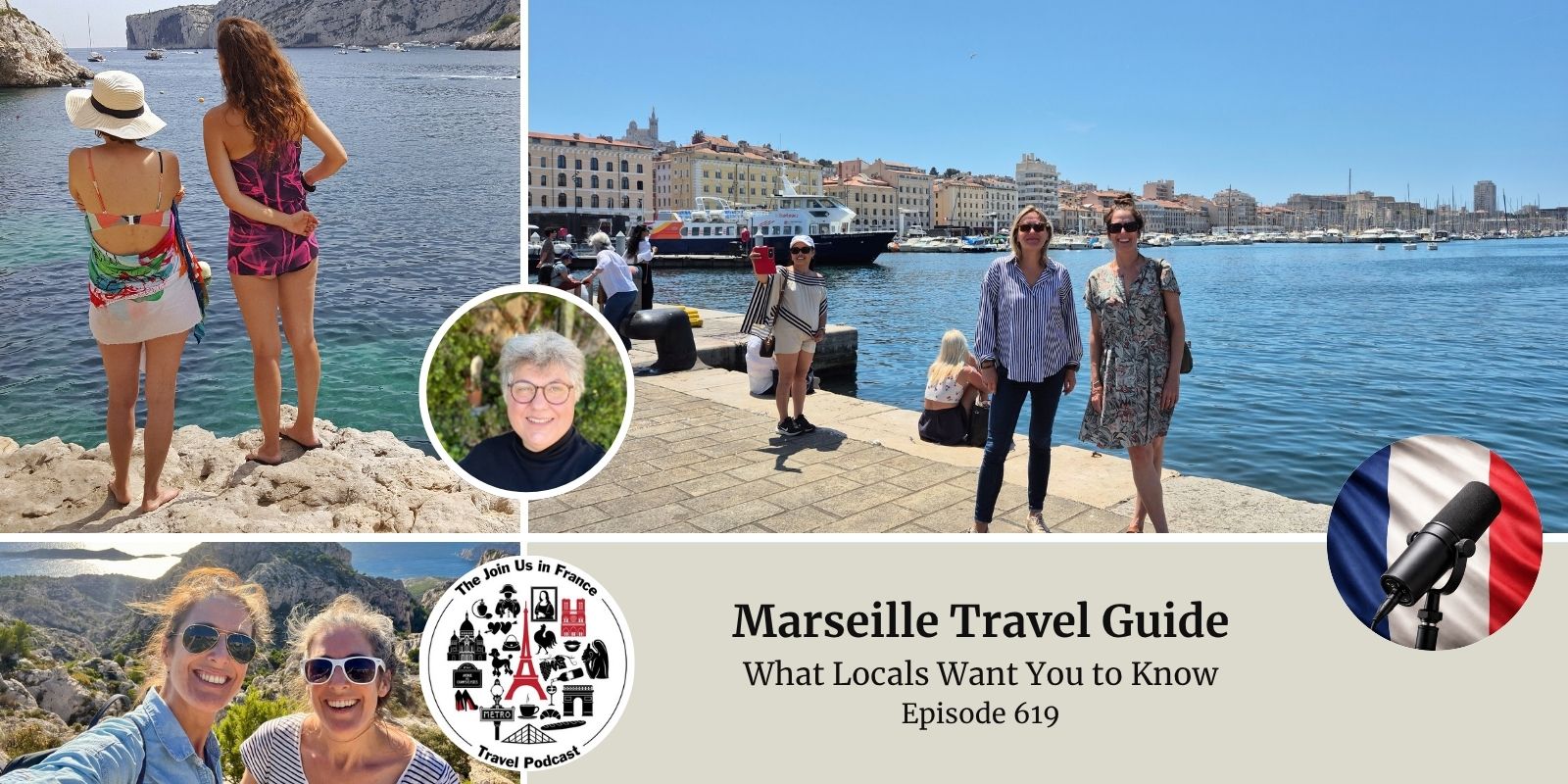
Marseille has a reputation, and most of it comes from the evening news. People who live there see a different city. For episode 619 I talked with two of them: Emilie Bonnel, a promotion officer at the Marseille Tourist Office, and Alexis Steinman, a food and travel writer who moved to Marseille and now guides there. This Marseille travel guide is built from what they want visitors to know.
Listen to this episode ad-free
Why Go in Winter
Alexis's favorite season is winter, and she makes a good case. Summers in Marseille are very hot. In winter the light comes in low and soft, the light that drew so many painters to Provence. There are fewer tourists, so it's easier to get a restaurant table and prices are lower.
The Calanques National Park, with its limestone cliffs and turquoise coves, is better for hiking in winter. In summer, parts of it sometimes close because of fire risk. Boats run all year.
It's also a good choice if you're coming for the holidays. Marseille has a00 Christmas market with santons, the small clay figurines of Provence, concerts in churches, and a big fireworks show at the port for New Year's. On a lucky day you can sit outside on a terrace in the sun at around 55°F (13°C). Small Provence villages are lovely, but in December many of them are very quiet. A big city always has something going on.
How Long to Stay
The first question in any Marseille travel guide is how long to stay. Emilie recommends three nights at the very least, and a week if you can. Marseille is France's second city, with about 900,000 people. Locals say it's made of 111 villages that grew together, and each neighborhood feels different. You can also use it as a base for day trips into Provence and come back to a city that's lively all year.
The tourist office sells a City Pass for one, two or three days, with public transport included.
Where to Stay in Marseille
For a first visit, the Old Port (Vieux-Port) puts you in the middle of everything. One warning from my own stay: it's loud at night. Ask for a room that faces away from the main street. Alexis points out that the two five-star hotels at the port, the Sofitel and the InterContinental, are set back a little, so you get the views without the noise. For an apart'hotel sort of stay consider Maison Juste or Les Apartements du Vieux Port
Other options they suggested:
- Endoume and Malmousque, right by the sea, if you want a neighborhood feel with your own boulangerie and café.
- Longchamp, near the Palais Longchamp: close to the center but much quieter.
- Cours Julien, the artsy district.
- La Joliette, the renovated business district near the MuCEM.
- Les Bords de Mer, a hotel right above a beach but still in the city.
Marseille has 26 miles of coastline, so the further down the coast you stay, the further you are from the center. Alexis suggests saving the beach stay for a second visit.
What to Eat and Drink
Alexis started out doing food tours, and she says food is the easiest way into Marseille, even if you don't speak French. It has been a port for its whole history, and you can taste that.
Bouillabaisse. It started as a poor fishermen's soup made from the leftover catch, with saffron, fennel and garlic. Now it's a gastronomic dish, and some places sell a tourist version. Alexis's two picks: Chez Michel, open since the 1940s, with waiters in white jackets, white tablecloths and good wine; and Le Grand Bar des Goudes, whose chef has just won the World Bouillabaisse Championship. Les Goudes is the last village in Marseille and the gateway to the Calanques, so the fish comes in practically next to your table.
Apéro with panisse and pastis. Panisse is a chickpea-flour fritter, cousin of socca in Nice. Alexis calls apéro the most important thing you do in Marseille. Pastis was created there in 1932 by Paul Ricard, when absinthe was banned. Besides the big brands, try two local ones: Pastis de la Plaine, where you can make your own bottle with your name on it, and Château des Creissaux by Guillaume Ferroni, aged in barrels and different every year.
The rest of the Mediterranean. Pizza with anchovies, brought by the Italians. Couscous from the large Algerian community. Figatelli, a Corsican pork-liver sausage, only available in winter. For pizza, Alexis sends people to Chez Étienne or Chez Zay, where the pizza is shared at the table as a starter. For fish, Boîte à Sardines is run by a fishmonger who buys from small local fishermen.
Book ahead, though not a month ahead as in Paris. Many places have no website, so you call or text. Carry cash, because some don't take cards.
What to See
The MuCEM. Opened in 2013, the year Marseille was European Capital of Culture, the Museum of European and Mediterranean Civilizations is reached through a 17th-century fort and across a footbridge over the water. Walking around the building and up to the roof is free. You pay only for the exhibitions.
Château d'If. The island prison that inspired Alexandre Dumas's The Count of Monte Cristo is a 20-minute boat ride from the Old Port. Learn from my mistake: I went at 7 a.m., saw a line and decided to come back later. By then the times I wanted were sold out, and the website wasn't working. Emilie's advice is to buy your tickets at the Old Port first thing in the morning and pick your time slot then.
Le Corbusier's Unité d'Habitation. Built in the early 1950s as a "vertical village", it looks a bit like a concrete cruise ship. Locals first called it la Maison du Fada, the Crazy House. You can visit the restaurant, café, bookshops and the rooftop for free, roughly 9 to 6. To see inside an apartment you need a tour with the tourist office, and Alexis recommends it.
More museums. The Cosquer Cave is a replica of a painted prehistoric cave whose entrance is under the sea in the Calanques; you ride through it in a small vehicle. I've seen nearly every painted cave open to the public in France, and this one ranks high. The Palais Longchamp, which Alexis says looks like a wedding cake, holds the Natural History Museum and the Fine Arts Museum, known for its paintings of the 1720 plague. The Marseille History Museum shows the remains of the Greek port. The city was founded by Greeks about 2,600 years ago.
The sea. Take a boat trip to the Calanques from Marseille or Cassis. You can also go diving, snorkeling or kayaking, or hire a catamaran for a sunset on the water, all year round. Just take the mistral seriously: when your phone says wind, it can be close to hurricane force.
Marseille on a Cruise Stop
Big cruise ships such as MSC and Costa dock a few kilometers from the center. Don't try to walk it: take the city bus or a taxi. Smaller ships, such as Ponant or Silversea, can sometimes dock right next to the MuCEM.
Emilie's plan for a day ashore: start at the Old Port with the morning fish market. Take the little tourist train up to Notre-Dame de la Garde, the basilica locals call la Bonne Mère, for a 360-degree view. Come back down for lunch, walk through Le Panier, the old quarter, and finish at the MuCEM.
Getting There Without a Car
The TGV from Paris takes about 3 hours 15 minutes, and there are direct trains from the Paris-Charles de Gaulle airport. Nice and Lyon are about two hours away. You don't need a car in Marseille, and trains reach Aix-en-Provence, Arles, Avignon, the Camargue and Cassis, which is just half an hour away.
Love It or Hate It
Alexis has guided at least 1,000 people, and she says Marseille is a city you either love or don't. It isn't Paris, which she calls a postcard, a museum that's awake. Marseille is a place to walk, smell and listen to. Its bad reputation goes back a long way, and like every big city it has areas that aren't for tourists. But judging it by the news isn't fair. Even my French family asked me what on earth I was going to do there. My answer: visit it. It's lovely.
If you want a city break and the sea in the same trip, this Marseille travel guide is a good place to start. Listen to the full episode for everything we didn't have room for here, including Olympique de Marseille, film and TV set in the city, and why the mistral keeps the sky so blue.
Disclosure: the Marseille Tourist Office paid for one night of my hotel stay. As always, the opinions are mine and my guests'.
Want more? My newsletter comes out around each episode, and it's where I share what's going on behind the scenes, not just the show notes. Sign up at joinusinfrance.com/newsletter.
Table of Contents for this Episode
More episodes about Provence
#JoinUsInFrance, #FrancePodcast, #Francophile, #FranceTravelTips, #FranceTravel, #TravelPodcast, #Marseille, #MarseilleTravel, #VisitMarseille, #Provence, #SouthOfFrance, #Mediterranean, #Bouillabaisse, #Calanques, #ChateauDIf, #MuCEM, #LeCorbusier, #WinterTravel, #FrenchFood, #CruiseTravel
FOLLOW US ON:
Subscribe to the Podcast
Apple YouTube Spotify RSSSupport the Show
Tip Your Guides Extras Patreon Audio Tours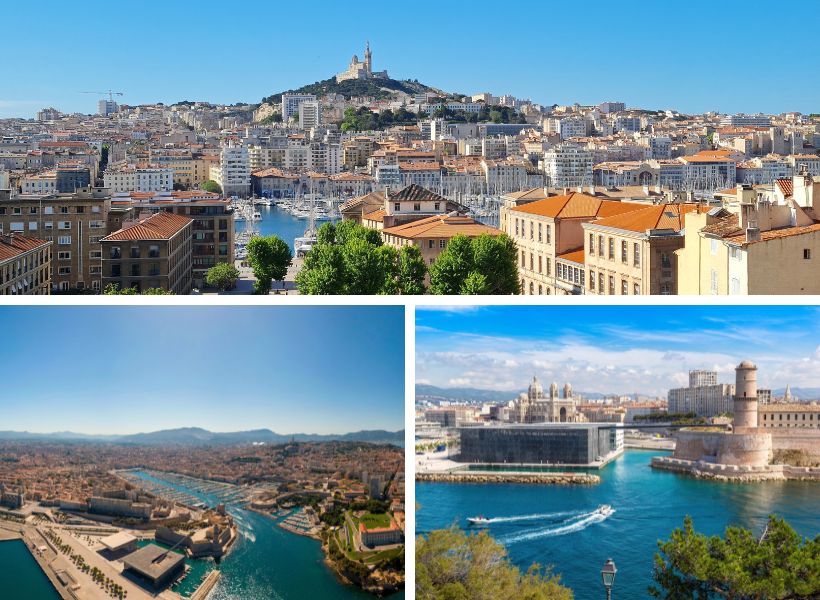
Read more about this episode
TranscriptCategory: Provence