Categories: Alsace and Lorraine, French History
This episode features our frequent and very popular guest Elyse Rivin. If you enjoy her episodes, please consider supporting her on Patreon.
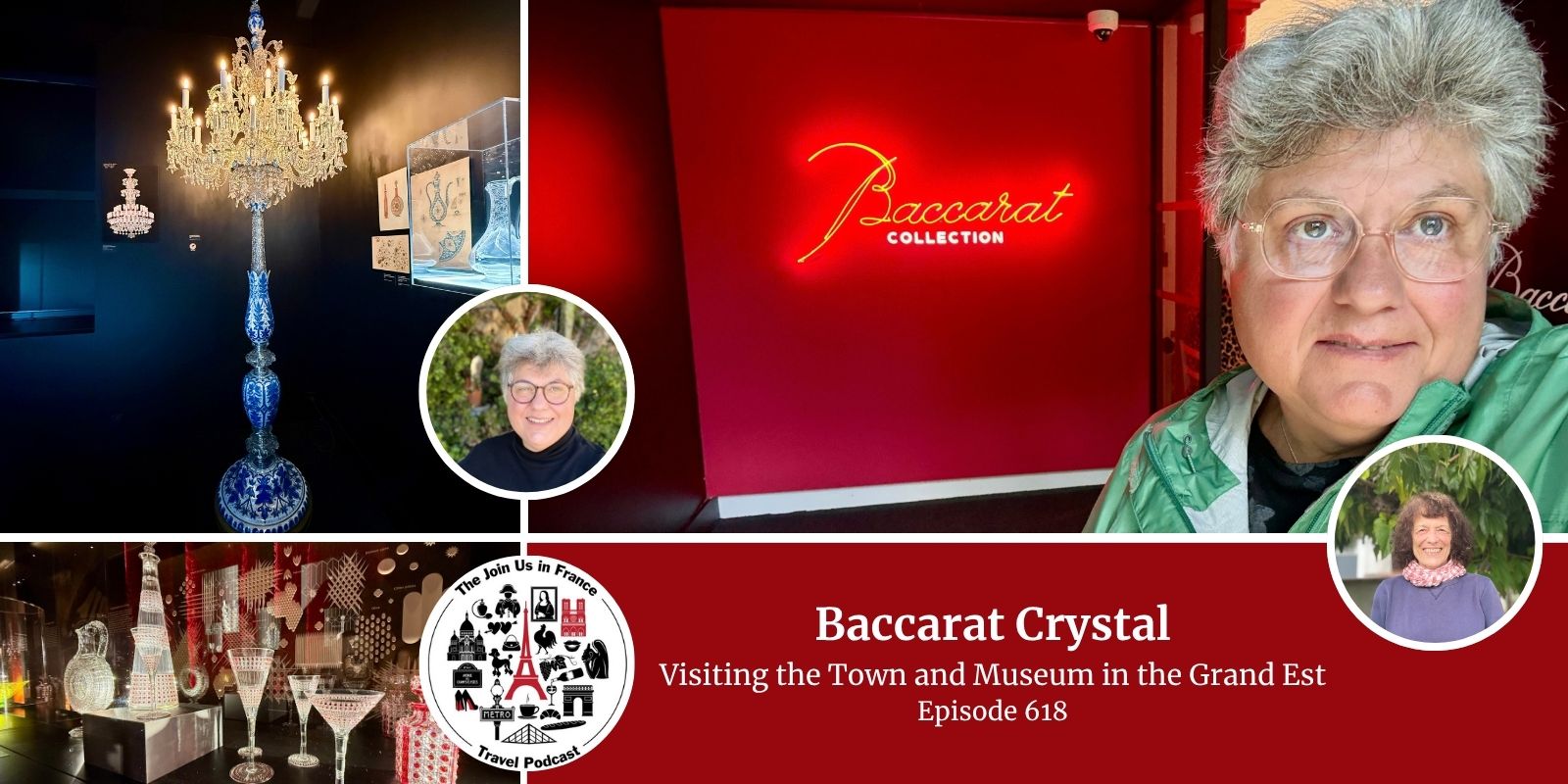
I'm not a crystal sort of person. I don't buy luxury goods and I don't follow fashion. But on May 12, 2026, I stopped in Baccarat, a small town in the Grand Est, and liked it a lot more than I expected. In episode 618, Elyse Rivin and I talk about the town, the Baccarat crystal museum, and how glass becomes crystal in the first place.
Listen to this episode ad-free
Where Is Baccarat?
Baccarat is in Meurthe-et-Moselle (department 54), about halfway between Nancy and Colmar. That makes it an easy stop if you're driving between the two. About 4,000 people live there, and the crystal manufacturer is by far the biggest employer. The town is small and everything is walkable: park once and do it all on foot.
Glass or Crystal?
Elyse explains that crystal is traditionally glass with lead oxide added. That's what makes it heavy, makes it sparkle, and makes it possible to cut facets into it. She gives three ways to tell whether you have real crystal:
- It rings when you tap the edge gently. Ordinary glass gives a dull "plunk."
- It throws a rainbow when you hold it up to direct sunlight.
- It's heavy compared with ordinary glass.
Northeastern France has made glass for centuries because the region had what glassmakers need: forests to burn and rivers to cool the work. Baccarat's neighbor, the Cristallerie de Saint-Louis, goes back even further, and the two companies have been producing high-end pieces side by side for a very long time.
Inside the Baccarat Crystal Museum
I spent an hour and a half to two hours in the museum. It isn't huge, but it's modern and well done. You can't visit the workshops, but films show the craftsmen at work. The brand dates to 1764, and the company still employs people in about 50 different specialized jobs. It has 13 Meilleurs Ouvriers de France on staff, which is the highest number of any company in France, and runs its own school. The glassblowers are called souffleurs de rêve, "dream blowers," and the cutters sculpteurs de lumière, "sculptors of light."
Things to look for:
- Le Rouge à l'Or: the signature red, perfected in 1839 by fusing clear crystal with 24-karat gold. Every Baccarat chandelier has at least one red drop, or pampille, as a signature.
- The chandeliers: Baccarat presented its first chandelier collection in 1827. The Zenith chandelier, from around 1850, has 24 lights and 1,000 hand-cut pampilles. In 1896, Tsar Nicholas II wanted his candelabra electrified, so Baccarat invented a hollow twisted branch, the Bambou Tors, to hide the wires.
- Cristal des Rois: the first royal order came in 1823 from Louis XVIII. You can see table services made for state visits, and the Élysée Palace still serves official dinners with glassware from 1899.
- Famous clients: a full set for Josephine Baker's wedding, and a sunburst clock owned by Marilyn Monroe.
- Perfume bottles: Guerlain's Shalimar and Vol de Nuit, and Dalí's Roi Soleil bottle for Schiaparelli in 1946.
- The paperweights: there are at least 100 of them, about the size of a fist, some with what looks like a meadow of flowers inside. They sell for thousands of euros. They're some of the most exquisite things I've ever seen.
Even if crystal isn't your thing, go to the Baccarat crystal museum for the craftsmanship.
Don't Skip the Église Saint-Rémy
The Saint-Rémy church is a short walk from the museum. It was destroyed during the war and rebuilt in concrete, which doesn't sound promising. But it's filled with thousands of pieces of Baccarat glass in every color they make: 52 colors in 150 shades. Go inside.
Baccarat also has a World War II story. The town was liberated on October 31, 1944, by General Leclerc's Second Armored Division. A local resistance member, Marcelle Cuny, guided Commandant Rouvillois's tanks around the German defenses. A panel in town tells the whole story. Also look for the Tour des Voués, which is left from the time when the town belonged to the bishops of Metz.
On the Way to Colmar: Sélestat
If you drive from Baccarat toward Colmar, you'll pass Sélestat, about 20 km north of Colmar. Stop there for the Bibliothèque Humaniste. This renovated library and museum is built around the collection of Beatus Rhenanus, a humanist born in Sélestat in 1485, who left his books to his hometown. One of them is the first book to use the name "America" for the new continent. The pages are behind glass, but touch screens let you "turn" them and read translations in French, English or German. I spent two hours there.
More Glass and Crystal Nearby
Elyse recommends the Cristallerie de Saint-Louis, where guided tours take you along a walkway above the workshops. There's also Daum in Nancy and Lalique in Wingen-sur-Moder. All of them are within a fairly small area.
Also in This Episode
In the magazine segment, I cover when SNCF opens holiday train bookings, and how a very secular France turned out for Pope Leo XIV's mass on the Place de la Concorde.
Want a short weekly recap of new episodes, France travel news, and what I'm paying attention to? Sign up for my free newsletter.
Table of Contents for this Episode
More episodes about the Grand Est
#JoinUsInFrance, #FrancePodcast, #TravelPodcast, #Francophile, #FranceTravel, #FranceTravelTips, #RealFrance, #VisitFrance, #Baccarat, #BaccaratCrystal, #FrenchCrystal, #SavoirFaire, #GrandEst, #Lorraine, #Alsace, #Nancy, #Colmar, #Selestat, #FrenchHistory, #RoadTripFrance
FOLLOW US ON:
Discussed in this Episode
- Baccarat
- Grand Est
- Meurthe-et-Moselle
- Moselle
- Vosges
- Lorraine
- Nancy
- Colmar
- Restaurant Chez Baptiste in Baccarat
- Sélestat
- Bibliothèque Humaniste de Sélestat
- Musée Baccarat
- Église Saint-Rémy (Baccarat)
- Tour des Voués
- Cristallerie de Saint-Louis (Saint-Louis-lès-Bitche)
- Daum Cristallerie (Nancy)
- Lalique (Wingen-sur-Moder)
- Épinal
- Pont-à-Mousson
Subscribe to the Podcast
Apple YouTube Spotify RSSSupport the Show
Tip Your Guides Extras Patreon Audio Tours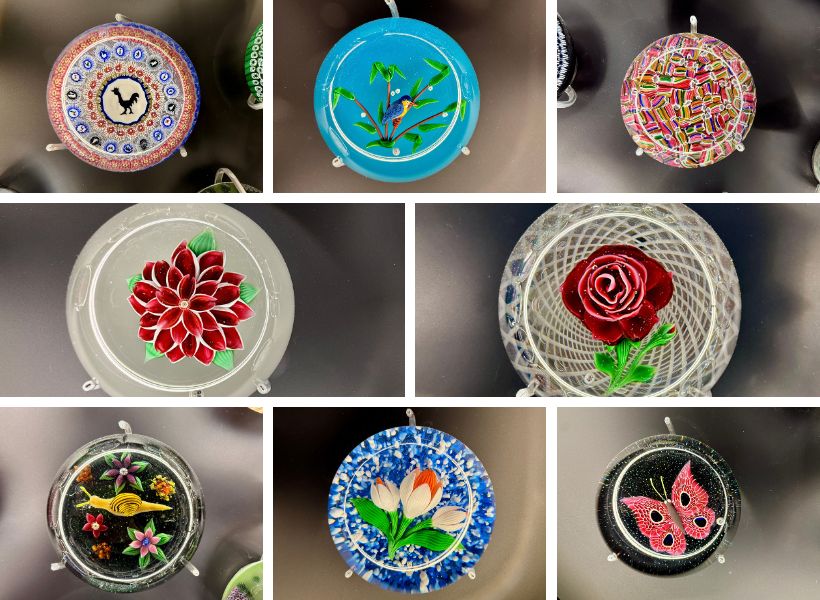
Read more about this episode
TranscriptCategories: Alsace and Lorraine, French History