
Category: French History
This episode features our frequent and very popular guest Elyse Rivin. If you enjoy her episodes, please consider supporting her on Patreon.
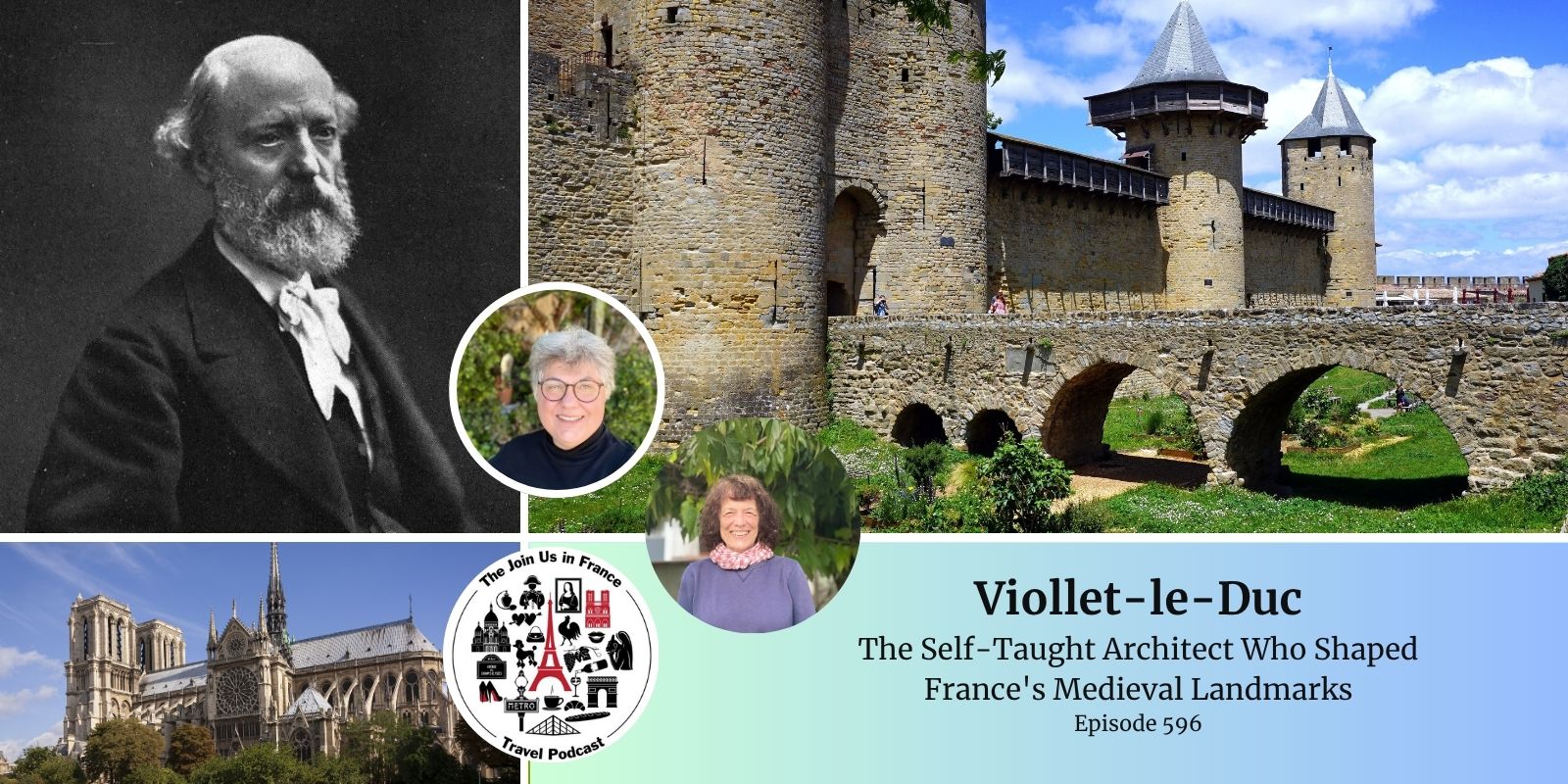
If you've visited Notre-Dame de Paris, Carcassonne, or the Chateau de Pierrefond near Compiègne, you've already seen his work — you just might not have known it. In episode 596 of Join Us in France, my friend and licensed tour guide Elyse Rivin joins me to talk about Eugène Emmanuel Viollet-le-Duc, the 19th-century architect who restored — and in many cases reinvented — some of the most visited medieval monuments in France.
Listen to this episode ad-free
A privileged start, an unconventional path
Viollet-le-Duc was born in Paris in 1814 and grew up in the Tuileries Palace, where his father served as head conservator of royal residences under King Louis Philippe. He was drawing with exceptional skill by age six. Everyone assumed he'd go to the École des Beaux-Arts. He refused. At 18, he said: "If I have talent, I will succeed whether I go to art school or not. And if I don't have talent, going to art school won't make any difference."
Instead, he spent two years traveling around France drawing medieval churches, châteaux, and fortifications — thousands of sketches and watercolors, many of which he sold, including one to the king. That self-directed education became the foundation for everything he did afterward.
The theory that changed French architecture
Viollet-le-Duc developed a theory that Gothic architecture was inspired by nature — pointed arches echoing leaves, ornamental details reflecting organic forms. Elyse and I both admit we're not entirely convinced, but what matters is that he was. He wrote about it extensively, and it's his writings, not his restorations, that became the direct inspiration for the Art Nouveau movement. Designers like Lalique and Gallé drew from his ideas. Le Corbusier and Frank Lloyd Wright both cited him as a reference. His influence spread further in England, Germany, and the United States than it ever did in France, which says something about how France treats its iconoclasts.
His approach to restoration was equally bold. He didn't believe in simply repairing what was there. He wrote that restoration means reestablishing a structure "in a complete form that maybe didn't exist at a given moment in time." In other words: make it better than it was. That philosophy made him both celebrated and controversial in his own lifetime.
What he added, and what got taken away
At Notre-Dame, he worked for 20 years starting in 1843. The Gallery of Kings, the chimeras, the spire, the apostles on the roof — all his. Saint Thomas on the roofline bears Viollet-le-Duc's own face, a detail you cannot see from the street. The recently restored Notre-Dame largely kept his vision intact, including his use of color and pigment inside the cathedral.
At Carcassonne, the slate-pointed tower roofs are his — and almost certainly wrong for the region's climate. He defended the choice by pointing to slate deposits in the nearby Black Mountains. Whether you agree or not, without his intervention, there might not be much of Carcassonne left to argue about.
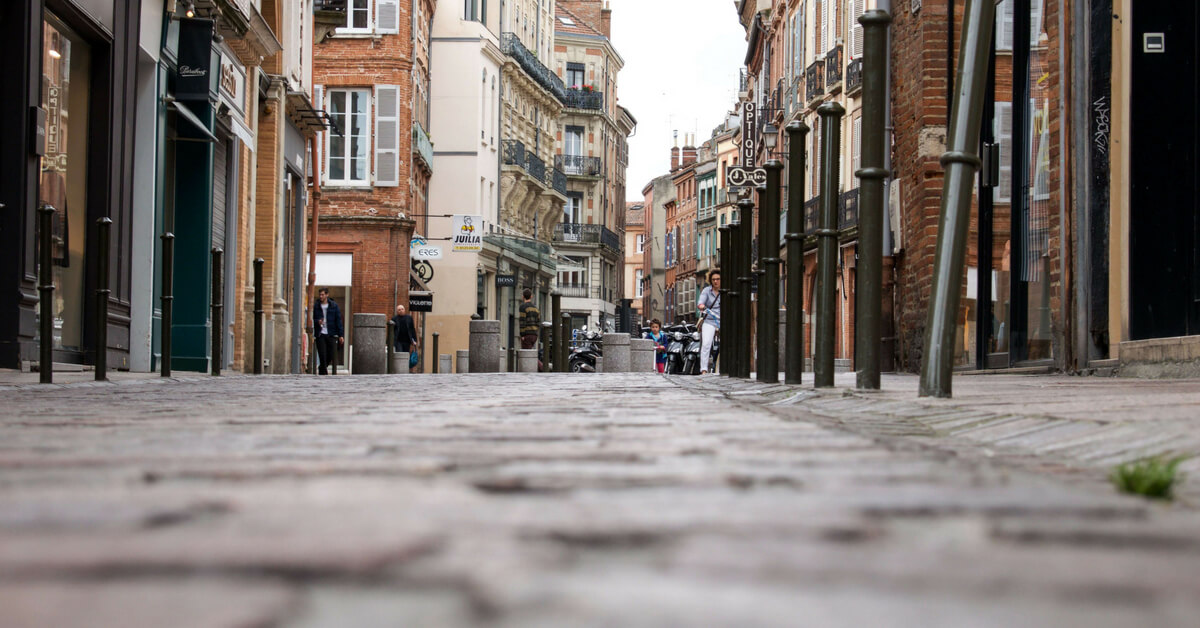
Saint-Sernin in Toulouse is the odd one out. It's the only project of his that was ever undone. He changed the roofing materials, added elements that didn't fit the original Romanesque style, and modified the bell tower. The city of Toulouse pushed back twice. He died in 1879 before the project was finished. And in the 1960s, a century later, the city tore out his work and rebuilt the basilica in its original materials. Elyse and I both find that remarkable.
How it ended
In 1870, Viollet-le-Duc built fortifications around Paris during the Franco-Prussian War. After criticizing the Paris Commune, he was condemned to death by it. He took his family and moved to Lausanne, Switzerland, where he spent the last eight years of his life restoring the cathedral there. He died quietly in 1879 and was buried in Lausanne with no official ceremony.
Just before leaving France, he was offered a full professorship at the Beaux-Arts — the school he'd famously refused at 18. He accepted, lasted six months, and quit.
This episode also includes a magazine segment on the Paris Catacombs, which reopened in April 2025 after a 5-million-euro renovation. New lighting now reveals carvings and inscriptions that were invisible before. Book well in advance — they cap visits at 2,000 people per day.
Want a short weekly recap of new episodes, France travel news, and what I'm paying attention to? Sign up for the free newsletter at joinusinfrance.com/newsletter.
More episodes about French history
#JoinUsInFrance, #FrancePodcast, #Francophile, #FranceTravelTips, #RealFrance, #ViolletLeDuc, #MedievalFrance, #FrenchHistory, #FrenchArchitecture, #NotreDameParis, #Carcassonne, #SaintSernin, #GothicArchitecture, #FranceTourism, #VisitFrance, #FranceTravel, #ToulouseGuide, #FrenchHeritage, #MedievalArchitecture, #FranceHistory
FOLLOW US ON:
Subscribe to the Podcast
Apple YouTube Spotify RSSSupport the Show
Tip Your Guides Extras Patreon Audio Tours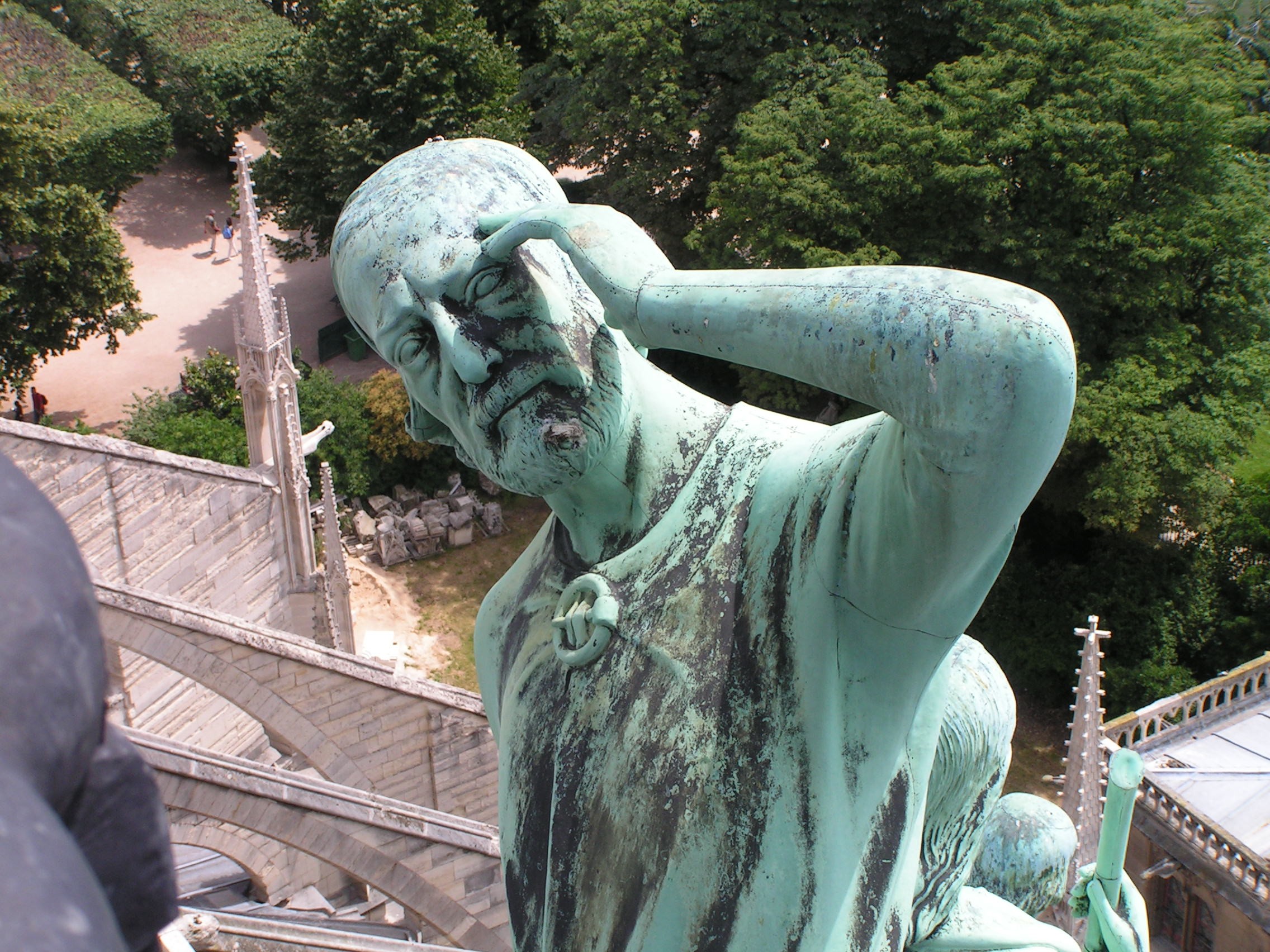
Read more about this episode
TranscriptCategory: French History